
As the nation remembers Martin Luther King Jr., much will be said about his life and his legacy; rightly so, for his words and actions have influenced many across America.
On April 4th, 1968, Martin Luther King was shot and killed; after being pronounced dead officially at St. Joseph’s Hospital, Robert Lewis Jr. from R.S. Lewis & Sons Funeral Home was contacted to conduct the funeral. When interviewed, Mr. Lewis reflected on his chance meeting with Dr. King a few days prior, recalling, that “I was pulling up at a red light and my pastor said Robert I want you to meet Dr. King and I said oh my gracious you know and we met like that.” Mr. Lewis prepared the body which Reverend Samuel Billy Kyles detailed the challenges of, saying, “The bullet had done so much damage to Martin’s face and the autopsy had caused a great deal of despair.” The task, according to the website honoringmlk.com, took Mr. Lewis and his brother, Clarence Lewis thirteen hours to complete. Time Magazine noted the excellence of the work, stating “… the black suit tidily pressed, the wound in the throat now all but invisible.”
Dr. King was laid to rest in a bronze casket, the material noted for its associations with nobility and offering superior resistance to corrosion. His first public viewing was at R.S. Lewis & Sons Funeral Home where hundreds if not thousands gathered including his wife who had been flown in on a plane specially arranged for her by Robert F. Kennedy.
After the visitation, Dr. King was taken to the airport by procession, escorted by police and national guardsmen. Mr. Lewis followed to Atlanta where he was personally thanked by members of the King family, but he declined any form of payment, stating, “Dr. King had already paid him with a lifetime of leadership.” Mr. Lewis also kept quiet for forty years about his role preparing Dr. King and Reverend Billy Kyles said Lewis passed up what could have been a fortune in book fees and recognition, stating “And that is powerful. That is powerful and he never boasted of it or bragged of it, he just did it cause it needed to be done.”
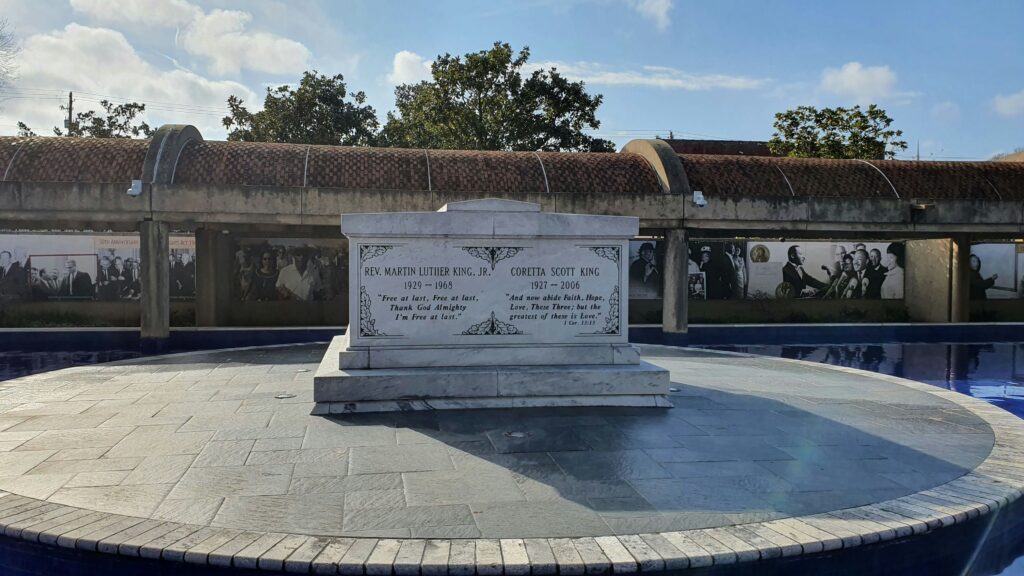
In Atlanta, Dr. King’s first funeral service was conducted at Ebenezer Baptist Church after lying in state at Spelman college. Over 1300 people attended the private services including politicians, civil rights leaders, movie stars, writers, athletes, and musicians. After the services concluded, Dr. King was placed into a humble farm wagon and a procession began from Ebenezer Baptist Church to Morehouse College where the public service would be held. The procession marched in silence while occasionally singing freedom songs; numbers of attendees at the procession vary by source, but are estimated to be 100,000 to 200,000 that accompanied Dr. King to the public service. Following the public service, Dr. King was brought to South-View cemetery where he rested until 1970 when a mausoleum was built. A reflecting pool and eternal flame were added to the site in 1977 and in November 2006, Dr. King’s wife, Coretta King was laid to rest next to him.
Author: Brian Rankin
Published: January 16, 2026